岡山大学(理系) 2025年 問題4
$下図のように、三角形ABC\ の外側で頂点または辺上の点からの距離が \ 1\ 以内にある、長方形および扇形$
$からなる領域を \ Z\ とする。さらに、AB=AC=3 \ \ とし、\angle ABC=\theta \ \ とおく。また、Z\ の面積を \ S_1\ とする。$
$以下の問いに答えよ。$
$\hspace{5em}$ 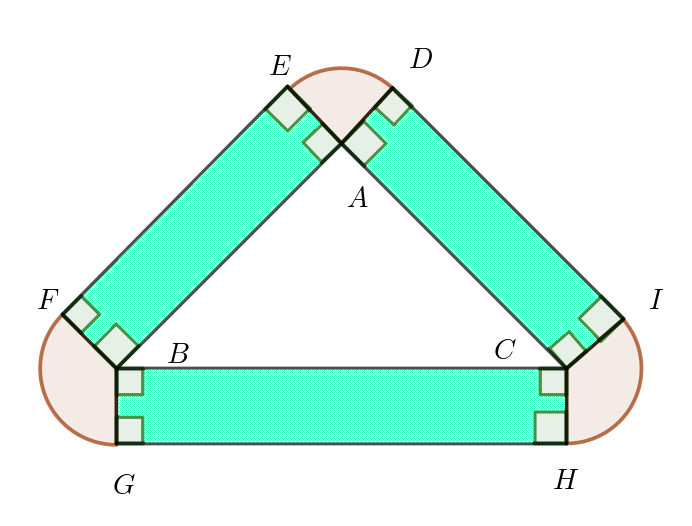
$(1)\ \ S_1 を求めよ。$
$(2)\ \ 三角形ABC\ の内接円の半径 \ \ r(\theta) \ \ を求めよ。$
$(3)\ \ 0 < \theta \leqq \dfrac{\pi}{4} \ \ のとき、(2)の \ r(\theta)\ の最大値を求めよ。$
$(4)\ \ (2)の内接円の面積を \ S_2\ とする。0 < \theta \leqq \dfrac{\pi}{4} \ \ のとき、S_1 >S_2\ \ を示せ。$
(1)
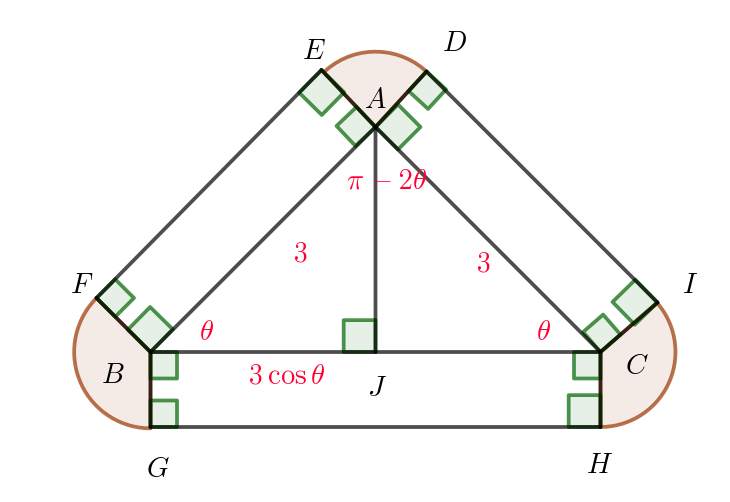
$頂点A\ から対辺BC\ に垂線 \ AJ\ を下ろすと$
$BJ=AB\cos \theta =3\cos \theta \quad だから \quad BC=6\cos \theta$
$長方形 BGHC=6\cos \theta \times 1=6\cos \theta $
$\angle BAC=\pi -2\theta \quad だから \quad \angle DAE=\pi -(\pi -2\theta)=2\theta$
$\angle FBG=\angle HCI=\pi -\theta$
$よって$
$扇型 ADE+扇型 BFG +扇型 CHI=\dfrac{\pi \times 1^2}{2\pi}(2 \theta +2(\pi -\theta))=\pi$
$したがって$
\begin{eqnarray*} S_1 &=&長方形 AEFB + 長方形 ACID + 長方形 BGHC+ 扇型 ADE+扇型 BFG+扇型CHI\\ \\ &=&3 \times 2 +6\cos \theta+\pi\\ \\ &=&\pi+6(1+\cos \theta)\\ \end{eqnarray*}
(2)
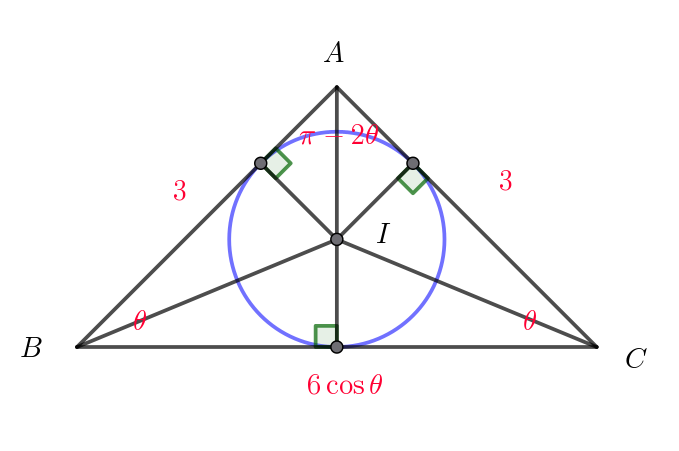
\begin{eqnarray*} \triangle ABC &=&\triangle ABI+\triangle BCI+\triangle CAI\\ \\ &=&\dfrac{r(\theta)}{2}(AB+BC+CA)\\ \\ &=&\dfrac{r(\theta)}{2}(3+6\cos \theta +3)\\ \\ &=&3r(\theta)(1+\cos \theta) \end{eqnarray*}
$一方$
$\triangle ABC=\dfrac{1}{2} \times AB \times AC \times \sin(\pi -2\theta)=\dfrac{9}{2}\sin 2\theta$
$よって \quad 3r(\theta)(1+\cos \theta)=\dfrac{9}{2}\sin 2\theta$
$r(\theta)=\dfrac{3\sin 2\theta}{2(1+\cos \theta)}$
(3)
$0 < \theta \leqq \dfrac{\pi}{4} \quad だから \quad 0 < 2\theta \leqq \dfrac{\pi}{2}$
$0 < \theta_1 < \theta_2 \leqq \dfrac{\pi}{4} \ \ をみたす \ \ \theta_1, \ \ \theta_2 \quad に対して$
$0 < \sin 2\theta_1 < \sin 2\theta_2$
$0 < \cos \theta_2 < \cos \theta_1 \quad だから \quad 0< \dfrac{1}{1+\cos \theta_1} < \dfrac{1}{1+\cos \theta_2}$
$よって \quad \dfrac{\sin 2\theta_1}{1+\cos \theta_1} < \dfrac{\sin 2\theta_2}{1+\cos \theta_2}$
$したがって \quad r(\theta)=\dfrac{3\sin 2\theta}{2(1+\cos \theta)}\ \ は \quad 0 < \theta \leqq \dfrac{\pi}{4} で 単調増加である。$
$r(\theta)\ は \ \ \theta=\dfrac{\pi}{4}\ \ で最大となり、最大値は$
$r(\dfrac{\pi}{4})=\dfrac{3 \times \sin \dfrac{\pi}{2}}{2(1+\cos \dfrac{\pi}{4})}=\dfrac{3}{2(1+\dfrac{1}{\sqrt{2}})}=\dfrac{3\sqrt{2}}{2(\sqrt{2}+1)}=\dfrac{3\sqrt{2}(\sqrt{2}-1)}{2}=\dfrac{3(2-\sqrt{2})}{2}$
$(研究)$
$通常は、r(\theta) \ の導関数をとって、増減を調べるが、この方法はかなりきつい。$
(4)
$0 < \theta \leqq \dfrac{\pi}{4} \ \ のとき$
$S_2=\pi r(\theta)^2 \ \ の最大値 \ N\ は(3)より$
$N=\pi \times \big(\dfrac{3(2-\sqrt{2})}{2}\big)^2=\dfrac{9}{4}(6-4\sqrt{2})\pi=\dfrac{9}{2}(3-2\sqrt{2})\pi$
$一方 (1)より \quad S_1=\pi+6(1+\cos \theta) \ \ の最小値 \ M\ は$
$M=\pi+6(1+\cos \dfrac{\pi}{4})=\pi +6(1+\dfrac{\sqrt{2}}{2})=\pi +3(2+\sqrt{2})$
\begin{eqnarray*} M-N &=&\big(\pi +3(2+\sqrt{2})\big) -\big(\dfrac{9}{2}(3-2\sqrt{2})\pi\big)\\ \\ &=&\big\{1-\dfrac{9}{2}(3-2\sqrt{2})\big\}\pi + 3(2+\sqrt{2}) \\ \\ &=&\dfrac{1}{2}(18\sqrt{2}-25)\pi + 3(2+\sqrt{2}) \\ \end{eqnarray*} $ここで、 (18\sqrt{2})^2-25^2=648-625=23 \quad だから \quad 18\sqrt{2}-25 >0$
$よって \quad M >N $
$すなわち \quad S_1\ の最小値が、S_2\ の最大値より大きいので、S_1 >S_2 $
メインメニュー に戻る